
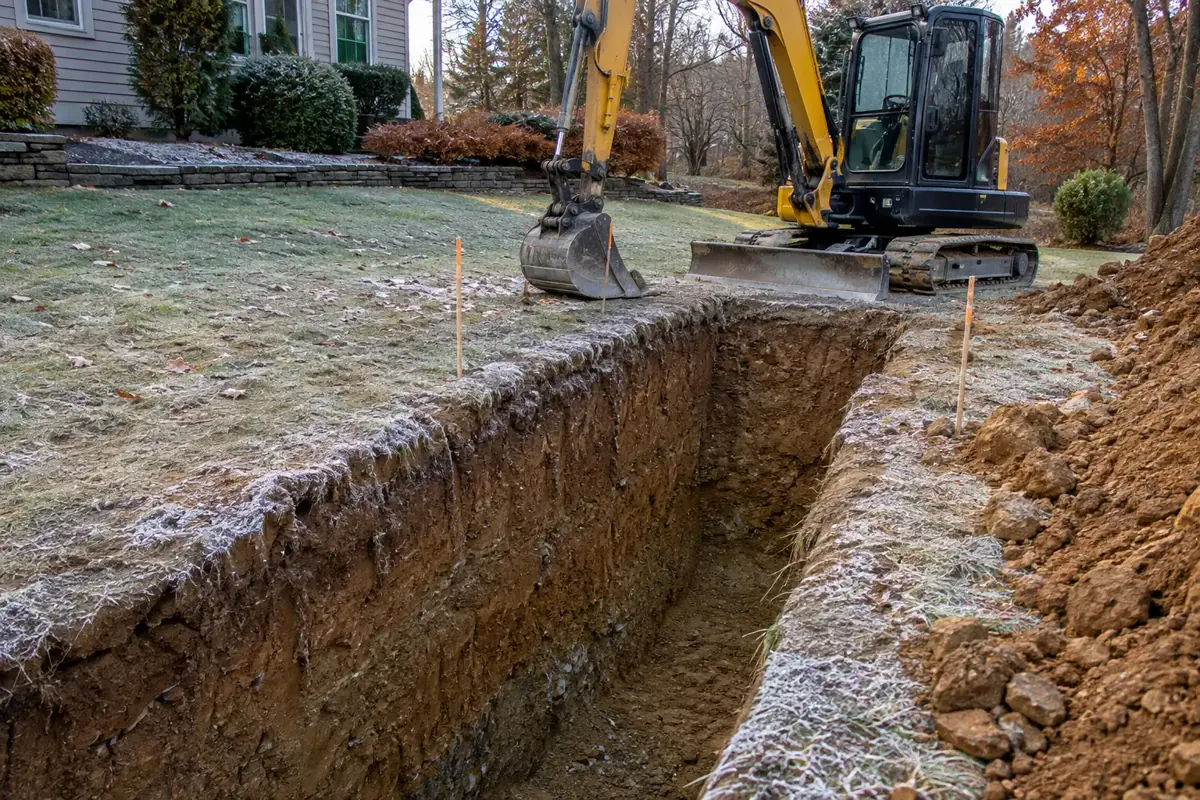
Every fall, we start fielding the same question from Glastonbury homeowners: "Can we still get this project done before winter?" And every spring, we get the opposite version: "Why can't you start until the ground thaws?" Both questions come back to the same underlying factor — the frost line, and how deep the ground actually freezes here in Central Connecticut.
If you've never worked with an excavation contractor before, the frost line might sound like a minor technical detail. In practice, it drives nearly every scheduling decision on a grading, foundation, drainage, or hardscape project in this state. Here's what it actually means and why it matters for your timeline.
What the Frost Line Actually Is
The frost line, or frost depth, is the depth below ground surface to which soil moisture is expected to freeze during a typical winter. It's determined by regional climate, soil composition, snow cover, and nearby heat sources, and it varies significantly by latitude — the maximum frost depth across the continental U.S. ranges from essentially zero in the Deep South to as much as 8 feet in the coldest northern regions.
In Connecticut, the standard design frost depth used by contractors and building departments is 42 inches below grade. This figure comes from the same frost-protection logic used in the International Residential Code, which requires footings, foundation walls, and other permanent structural supports to extend below the frost line (or be otherwise protected from frost) so the freezing and thawing of soil doesn't heave and crack them.
Why the Frost Line Matters for Excavation and Grading
1. Footings and Foundations Must Go Below It
Any structure requiring a footing — a foundation wall, a deck post, a retaining wall footing — needs to extend to at least 42 inches below finished grade in Connecticut, unless it's protected by an approved alternative method like a frost-protected shallow foundation. This isn't a suggestion; it's a structural requirement, because footings sitting above the frost line are subject to frost heave: as soil freezes, it expands, and that expansion can lift and crack an under-built footing over successive winters. That's why a retaining wall or patio installed "on the cheap" without proper footing depth often starts showing cracks and shifting within just a few freeze-thaw cycles.
2. Frozen Ground Changes What's Excavatable
Once topsoil freezes, it behaves completely differently under excavation equipment. Frozen ground is harder to cut cleanly, harder to grade to an accurate slope, and far more likely to produce large, unworkable clumps rather than the fine, compactable material a project needs for proper backfill. Grading work in particular depends on being able to shape and compact soil to a consistent slope — something that's difficult to do reliably once the top several inches (or more, during a hard freeze) have turned solid.
3. It Shapes the Realistic Work Season
In practice, this means the ground in Glastonbury typically has a workable excavation window from roughly early spring, once frost has left the ground, through late fall, before sustained freezing sets back in. Projects requiring deep footings — retaining walls, foundation work, water and sewer line installation — are especially sensitive to this window, because digging a 42-inch-plus trench through frozen ground is slower, harder on equipment, and more expensive than digging the same trench in unfrozen soil.
This is also why fall is often the busiest season for excavation contractors in Connecticut: homeowners are racing to get footings in and backfilled before the ground locks up, which can create a scheduling crunch if a project isn't planned early enough.
Connecticut's Frost Season Is Slowly Shifting
Climate data from UConn's Institute for Resilience & Climate Adaptation (CIRCA) shows Connecticut's frost season has been trending shorter. Historical and projected data show the average number of annual frost days (days when the low temperature drops below 32°F) is expected to fall from roughly 124 to about 85 by mid-century under current warming trends. Connecticut's statewide average temperature has already risen more than 3°F since 1895, according to NOAA climate data cited by UConn researchers.
That doesn't mean the 42-inch code requirement is going anywhere — frost depth standards are based on worst-case design conditions, not average winters, precisely because a single hard freeze can still drive frost deep into the ground even in a generally milder year. But it does mean the practical excavation season in Connecticut has been gradually lengthening at the margins, giving homeowners and contractors a bit more flexibility at the start and end of the traditional digging season than a generation ago. That said, permafrost-style planning still applies every winter: once a hard freeze sets in, it sets in for the whole season, regardless of long-term averages.
What This Means for Planning Your Project
- Foundation, retaining wall, and footing work should be scheduled with the frost season in mind. Starting a deep-footing project too late in the fall risks the job getting frozen out before backfill and finish grading are complete.
- Drainage and grading projects that don't require deep footings have more scheduling flexibility, but still work best in unfrozen soil for accurate slope and compaction.
- Water and sewer line installation, which often requires trenching well below the frost line anyway, is less weather-dependent once the ground is workable, but the trenching itself is significantly slower in partially frozen conditions.
- Spring scheduling fills up fast. Because so many projects are paused over winter, contractors in Glastonbury and the surrounding towns typically see a surge of demand as soon as the ground thaws, so booking early in the season (or even over winter for a spring start) tends to get better scheduling outcomes.
FAQs
Is 42 inches the frost depth everywhere in Connecticut, or does it vary by town? Forty-two inches is the standard design frost depth applied across Connecticut and is consistent with the frost protection methods referenced in the International Residential Code. Local building officials can require adjustments based on specific site conditions, soil type, or exposure, so it's worth confirming with your town's building department for anything requiring a permit.
Can excavation happen at all once the ground freezes? It can, but it's slower, harder on equipment, and more expensive, since frozen soil has to be broken up before it can be moved or graded accurately. Most contractors, including us, plan major footing and grading work around the unfrozen season whenever possible and reserve winter work for urgent or weather-tolerant projects.
What happens if a footing isn't dug deep enough below the frost line? The footing becomes vulnerable to frost heave, meaning seasonal freezing and thawing of the soil beneath it can gradually lift, tilt, or crack the structure above it. This is one of the most common causes of cracked patios, shifting retaining walls, and uneven walkways in older Connecticut properties that were built without proper footing depth.
Does a frost-protected shallow foundation avoid the 42-inch requirement? In some cases, yes. Frost-protected shallow foundation methods use insulation to keep soil beneath and around a structure from freezing, allowing for shallower footings on heated buildings. These require specific design criteria and are typically better suited to new construction than retrofits.
How far in advance should I schedule excavation work in Glastonbury? Given the concentrated spring-through-fall work window in Connecticut, booking at least a few weeks to a couple of months ahead is a good rule of thumb, especially for larger foundation, drainage, or hardscape projects — and earlier still if you're hoping for a specific fall completion date before the ground freezes.
Sources
- International Residential Code, frost protection requirements (footing depth referenced consistently across state adaptations, including Connecticut's 42-inch standard) — summarized via state building code resources including law.cornell.edu
- Wikipedia, "Frost line," citing maximum U.S. frost depth ranges — en.wikipedia.org/wiki/Frost_line
- UConn CIRCA, "Rising Temperatures & Precipitation in Connecticut" fact sheet — resilientconnecticut.uconn.edu
- UConn CIRCA / Yale Center on Climate Change and Health, "Climate Change and Health in Connecticut" webinar data (NOAA-sourced temperature trends) — resilientconnecticut.uconn.edu