
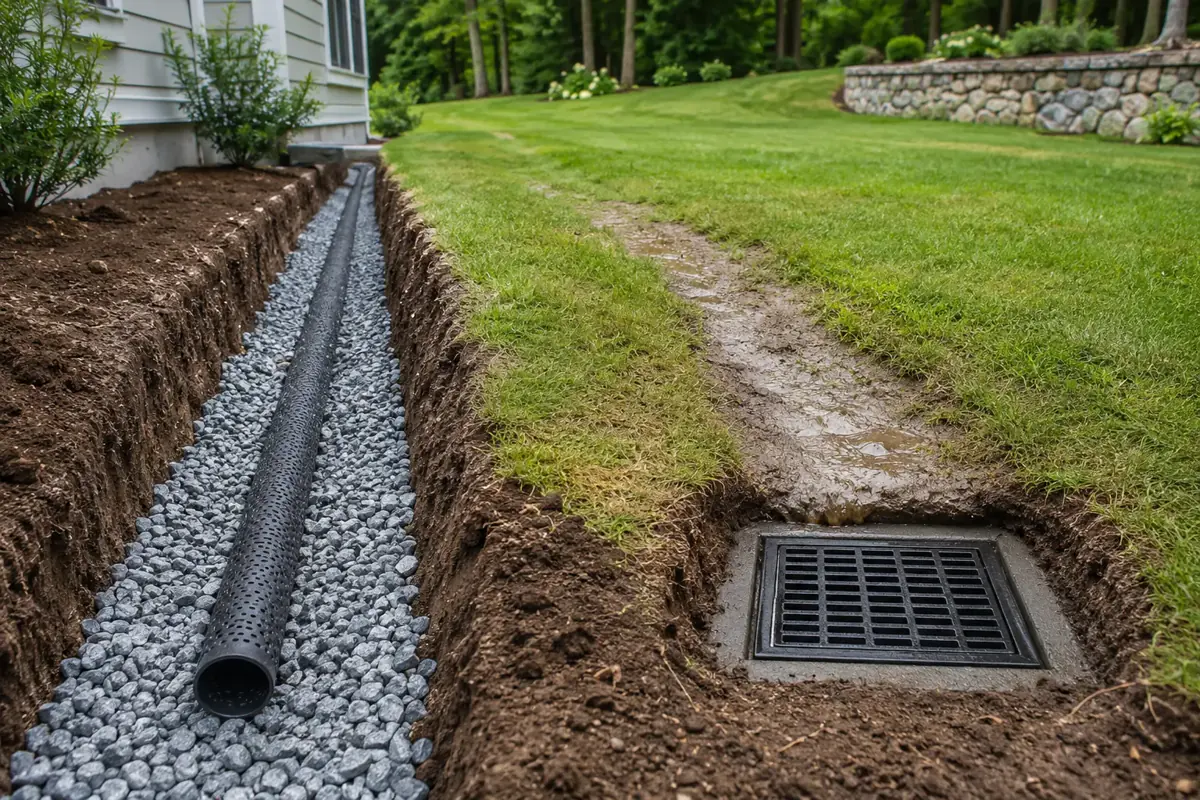
One of the most common questions we get from homeowners in Glastonbury and the surrounding Hartford County towns is some version of: "Do I need a French drain, or do I need a catch basin?" It's a reasonable question, because both systems solve water problems, both involve digging a trench, and both show up constantly in landscaping ads promising to fix a wet yard. But they're built to solve different problems, and installing the wrong one is one of the most common (and expensive) drainage mistakes we see on Connecticut properties.
This guide breaks down how each system actually works, what they cost, and — most importantly — which one fits the kind of soil and rainfall patterns we deal with here in Central Connecticut.
How a French Drain Works
A French drain is a trench dug to a specific depth and slope, lined with landscape fabric, filled with gravel, and fitted with a perforated pipe running along the bottom. Water in the surrounding soil seeps through the gravel, enters the pipe through its perforations, and travels by gravity to a discharge point — often daylighting downhill, tying into a dry well, or connecting to a stormwater system.
French drains are designed to manage subsurface water: groundwater, water table fluctuations, and moisture moving through soil, especially near a foundation. A footing drain (sometimes called a foundation drain) is really just a French drain installed at the base of a foundation wall specifically to relieve hydrostatic pressure and keep basements dry.
Best for:
- Foundation seepage and chronically damp basements
- Soggy sections of lawn caused by a high water table
- Retaining wall backfill drainage
- Sloped yards where water moves through the soil rather than across the surface
How a Catch Basin Works
A catch basin is a below-grade collection box, usually plastic or concrete, set into the lowest point of a problem area with a grated lid at the surface. Surface water flows into the grate, collects in the basin (which often has a sediment sump to trap debris), and exits through a connected pipe to a discharge point.
Catch basins are designed to manage surface water — the water you can actually see running or pooling across your lawn, driveway, or patio during and immediately after a storm.
Best for:
- Low spots where visible runoff collects
- The bottom of a sloped driveway or paved area
- Downspout runoff that needs to be captured and redirected
- Yards receiving heavy surface flow from a neighboring or uphill property
The Core Difference, in One Sentence
A French drain intercepts water moving through the ground. A catch basin captures water moving across the ground. Confusing the two is how homeowners end up with a beautifully installed system that does nothing for their actual problem — a French drain won't help if the issue is a driveway dumping runoff into your garage, and a catch basin won't stop water pressure building against a foundation wall from a high water table.
Why This Distinction Matters More in Connecticut
Glastonbury and much of the surrounding Hartford County area sit on a mix of glacial till and documented clay deposits, according to USGS soil mapping of the region. Clay-heavy soil has a low percolation rate — water moves through it slowly, which affects both systems differently:
- For French drains, slow-draining clay soil means the gravel trench needs to be sized generously and the perforated pipe needs a reliable discharge point, or the trench itself can become a saturated reservoir that overflows during heavy storms rather than draining away.
- For catch basins, clay soil actually plays to their strength, since they're designed to move surface water directly into a pipe rather than relying on the soil to absorb it.
This is also where Connecticut's shifting rainfall patterns come in. Data from UConn's Institute for Resilience & Climate Adaptation shows the state's heavy precipitation days — storms producing more than an inch of rain — are increasing, with maximum single-day precipitation totals projected to rise significantly by mid-century. Systems sized for "typical" storms a generation ago are increasingly undersized for what actually falls today, which is a big part of why so many older Glastonbury properties are only now developing drainage problems they never had before.
Cost Comparison
According to HomeAdvisor's national cost data, updated for 2025:
- French drains average around $9,250 installed, with a typical range of $500 to $18,000, or roughly $10 to $100 per linear foot (about $45 per foot on average). Cost depends heavily on trench depth, length, and whether the drain is a simple yard drain or a full foundation perimeter system.
- General yard drainage systems, which often include catch basins, average around $4,620, with most projects falling between $2,145 and $7,162, or about $10 to $25 per linear foot.
The gap makes sense once you understand what drives cost. French drains are typically dug deeper and longer (sometimes wrapping an entire foundation perimeter), while catch basins are usually installed at a few key collection points and connected with shorter pipe runs. A project addressing both surface and subsurface issues — common on clay-heavy CT lots — will usually land somewhere between these ranges, depending on how much of each system is required.
Can You Use Both Together?
Yes, and on many Glastonbury properties, that's exactly the right answer. A common configuration we install combines a French drain along a foundation or retaining wall with one or more catch basins positioned at the yard's low points, both tied into a shared solid discharge pipe leading to daylight, a dry well, or the storm system. This handles subsurface pressure and visible surface pooling in one integrated system, rather than solving half the problem and leaving the other half for next spring.
Maintenance Differences
- Catch basins need periodic cleaning. Their sediment sumps collect leaves, dirt, and debris, and a clogged basin stops draining almost entirely. Plan on checking and clearing them at least twice a year, especially after fall leaf drop.
- French drains are lower-maintenance day to day but harder to inspect, since the pipe is buried. Over years, sediment or root intrusion can reduce flow, which is why proper landscape fabric and gravel sizing during installation matter so much — a poorly built French drain is expensive to diagnose and repair later.
FAQs
Which system is better for a wet basement? A French drain (specifically a footing or foundation drain) is almost always the right tool for basement moisture caused by groundwater or hydrostatic pressure. A catch basin won't address water pressure building against foundation walls.
Which system is better for a soggy backyard where water just sits after rain? If the water is sitting on top of the ground rather than saturating the soil beneath it, a catch basin tied to a solid discharge pipe is typically the more direct fix.
Do I need a permit to install a French drain or catch basin in Glastonbury? It depends on the scope of work and whether the property is near wetland-classified soils, which Connecticut defines based on drainage class. A contractor familiar with local soil mapping can tell you early whether your project needs town review before digging.
How deep does a French drain need to be in Connecticut? Depth depends on what the drain is solving — a simple yard French drain might only need to be 18-24 inches deep, while a foundation perimeter drain typically needs to sit near the base of the footing, which can mean digging several feet down depending on your foundation depth.
Will a French drain freeze and stop working in the winter? A properly installed French drain, buried below the active frost zone with a functioning discharge point, continues to work through winter. Problems usually arise when a drain is installed too shallow or the outlet itself freezes and blocks flow.
Sources
- HomeAdvisor, "How Much Does a French Drain Cost in 2025?" — homeadvisor.com
- HomeAdvisor, "How Much Does It Cost to Install a Drainage System in Your Yard" — homeadvisor.com
- U.S. Geological Survey, "Map Showing Thickness of Principal Clay Unit, Glastonbury Quadrangle, Connecticut" — usgs.gov
- UConn CIRCA, "Rising Temperatures & Precipitation in Connecticut" fact sheet — resilientconnecticut.uconn.edu