
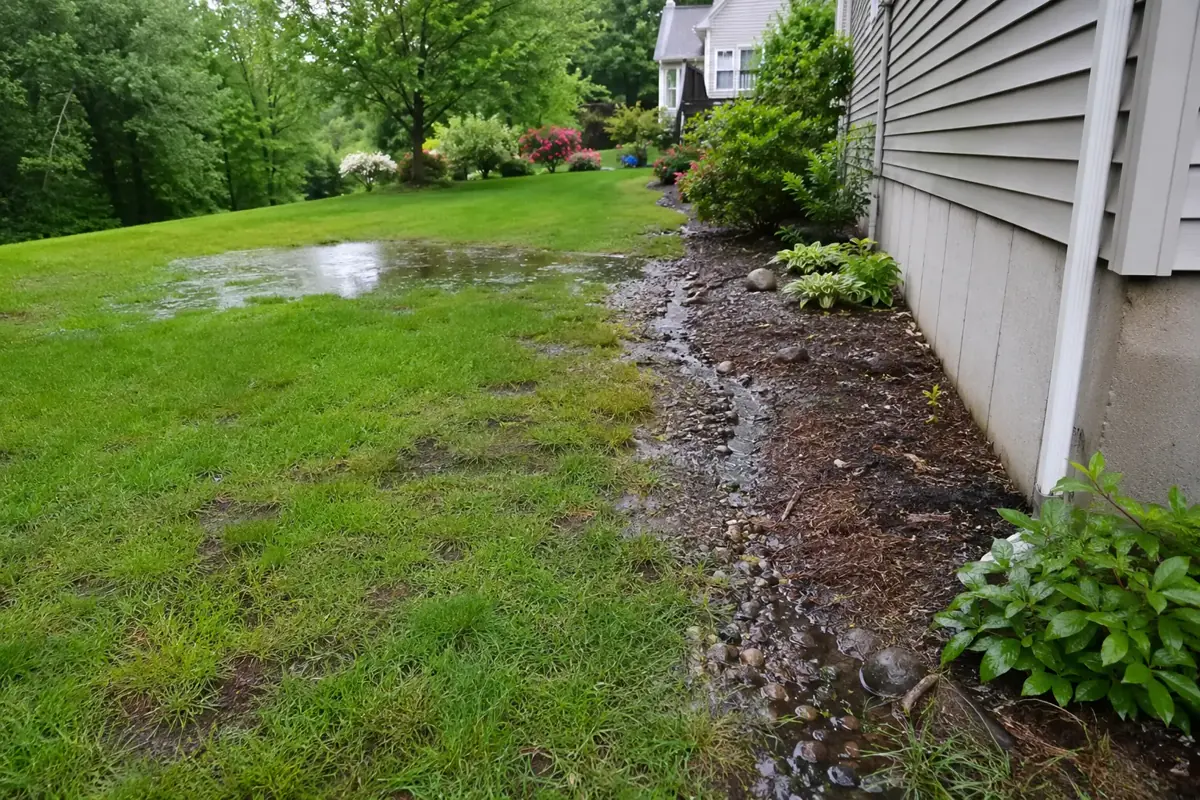
If you've lived in Glastonbury for more than a season or two, you've probably noticed how differently water behaves on your property depending on the time of year. A yard that drains fine in July can turn into a swamp in April. A basement that's been bone-dry for a decade can suddenly develop a musty smell after one unusually wet fall. That's not bad luck — it's usually a drainage system (or lack of one) finally getting overwhelmed.
Here at Elevated Earthwork, we get calls almost every spring from Glastonbury homeowners who "never had a water problem until this year." In nearly every case, the warning signs had been there for months, sometimes years, before the flooding started. This guide walks through what to actually watch for, why Glastonbury properties are more prone to drainage issues than people expect, and when it's time to bring in a professional before a small puddle becomes a five-figure repair.
Why Drainage Problems Are So Common in Glastonbury
Glastonbury sits along the Connecticut River, and much of the town was built on a mix of glacial till and fine-grained clay deposits. According to U.S. Geological Survey mapping of the Glastonbury quadrangle, the area has a documented layer of clay-rich soil beneath much of the town — the kind of subsurface material that drains slowly and holds water close to the surface long after a storm passes. Connecticut's own wetland soil classifications, maintained through the state's soil survey data, define "poorly drained" and "very poorly drained" soils largely by this same characteristic: water just doesn't move through them quickly.
Add in the fact that Connecticut's rainfall patterns are shifting. Research from the University of Connecticut's Institute for Resilience & Climate Adaptation (CIRCA) shows that statewide precipitation has been increasing by about 0.17 inches per decade since 1985, with the largest gains occurring in fall, and that annual precipitation is projected to rise roughly 8% (about 4 additional inches per year) by 2050. The same research shows heavy precipitation days — storms dumping more than an inch of rain — are expected to become more frequent. In plain terms: a drainage system that was "good enough" for a 1990s-era storm pattern is increasingly not good enough today, especially on clay-heavy lots.
Early Warning Signs Most Homeowners Miss
1. Water That Sits for More Than 24 Hours
A little puddling right after a downpour is normal. But if you can still see standing water in the same low spot a full day (or two) after the rain stops, your soil isn't absorbing or shedding water fast enough. This is often the very first sign of a grading or subsurface drainage issue, and it's the easiest one to catch early because it's visible from your window.
2. Soggy or Spongy Turf in Consistent Spots
If certain areas of your lawn feel spongy underfoot even on dry days, or if grass in those spots is thinner, yellowing, or growing more slowly than the rest of the yard, the root zone is likely staying saturated. Grass roots need oxygen; waterlogged soil suffocates them.
3. Mulch, Stone, or Topsoil Washing Away
Erosion channels — small trenches carved into mulch beds, gravel paths, or bare soil — mean water is moving with enough force and volume to carry material with it. This usually points to a grading problem: water is being funneled toward your house or a low point instead of being redirected away from it.
4. A Musty Smell in the Basement or Crawlspace
This is one of the most reliable early indicators of a drainage issue, and it often shows up months before you ever see actual water. A persistent musty odor usually means moisture is migrating through your foundation walls or slab, even if it's not pooling visibly yet.
5. Efflorescence or Cracking on Foundation Walls
That white, chalky residue on basement walls (efflorescence) forms when water moves through concrete or masonry and leaves mineral deposits behind as it evaporates. Combined with hairline cracks, it's a strong sign that hydrostatic pressure from saturated soil is pushing against your foundation.
6. A Sump Pump That Runs Constantly
An occasional cycle during a storm is expected. A sump pump running every few minutes, even on dry days, means groundwater is chronically elevated around your foundation — a sign that the soil around your home simply can't shed water fast enough on its own.
7. Ice Patches or Black Ice in the Same Spots Every Winter
If a section of your driveway or walkway consistently ices over before anywhere else, water is collecting and freezing there. That's a strong seasonal indicator of poor surface drainage, and it becomes a safety issue when temperatures drop.
8. Mosquito Activity That Won't Quit
Standing water for more than a few days is exactly what mosquitoes need to breed. If certain parts of your property are unusually buggy every summer, there's a good chance that's the same low spot causing your winter ice problem and your spring pooling.
9. Water Stains or Peeling Paint on Interior Walls Near Grade
When exterior grading slopes toward the house instead of away from it, moisture can wick into walls at or below grade level, showing up as stains, bubbling paint, or a soft texture on drywall.
Why This Matters Financially, Not Just Cosmetically
Water damage isn't a rare, unlucky event — it's one of the most common insurance claims homeowners file. According to the Insurance Information Institute, roughly one in 50 homeowners files a water damage claim in a given year, and these claims account for close to a quarter of all homeowners insurance claims nationally, with an average payout north of $11,000. Standard homeowners policies typically exclude damage caused by groundwater seeping through foundation walls or floors — exactly the kind of damage caused by long-term drainage problems rather than a single storm event. That means the drainage-related damage most likely to affect a Glastonbury home is often the type least likely to be covered.
What Actually Fixes These Problems
Once you've spotted one or more of these signs, the fix depends on the root cause:
- Poor surface grading is corrected by re-grading the lot so water sheds away from the foundation at the recommended slope, typically a minimum of 6 inches of fall over the first 10 feet from the house.
- Subsurface saturation near a foundation is often addressed with a French drain or footing drain system that intercepts groundwater before it reaches the walls.
- Isolated low spots or heavy surface flow — like a driveway apron or a yard that collects runoff from a neighboring property — are usually better solved with a catch basin tied into a piped outlet.
- Combination problems, which are common on clay-heavy Glastonbury lots, often need both grading correction and a subsurface system working together.
A proper drainage assessment starts with a site walk during or right after a rain event, when the problem areas are easiest to see, followed by a look at your lot's overall grade, soil composition, and where water naturally wants to go.
FAQs
How long does it usually take for a drainage problem to cause real damage? It varies, but chronic saturation near a foundation can begin causing hairline cracking and moisture intrusion within one to two wet seasons. Isolated surface pooling in the yard can take longer to become a structural issue but will keep killing landscaping and creating ice hazards in the meantime.
Can I fix minor drainage issues myself? Simple fixes like extending downspouts away from the foundation or filling small low spots with topsoil can help at the margins. But if water is pooling for more than a day, if you're seeing foundation staining, or if the problem repeats every season, the underlying grade or subsurface water table usually needs professional correction.
Does Glastonbury have specific rules about altering drainage or grading? Because Connecticut regulates wetlands based on soil classification (including poorly and very poorly drained soils), grading or drainage work near wetland-classified soils may require review. A local excavation contractor familiar with Glastonbury's soil maps can tell you early whether your project needs permitting.
Is a French drain or a sump pump the better fix? They solve different problems. A French drain intercepts and redirects water before it reaches your foundation. A sump pump manages water that has already gotten inside, typically through a basement drainage channel. Many homes with chronic issues benefit from both working together.
How much does it typically cost to fix a yard drainage problem? National data from HomeAdvisor puts the average yard drainage system installation around $4,620, with most projects falling between roughly $2,100 and $7,200 depending on yard size, soil conditions, and system type. Costs on clay-heavy or larger Glastonbury lots can run toward the higher end of that range.
Sources
- U.S. Geological Survey, "Map Showing Thickness of Principal Clay Unit, Glastonbury Quadrangle, Connecticut" — usgs.gov
- CT ECO / Connecticut Inland Wetlands Soils Data — cteco.uconn.edu
- UConn CIRCA, "Rising Temperatures & Precipitation in Connecticut" fact sheet — resilientconnecticut.uconn.edu
- Insurance Information Institute water damage claims data, via AAA/MAPRE Insurance — info.oregon.aaa.com
- HomeAdvisor, "How Much Does It Cost to Install a Drainage System in Your Yard" — homeadvisor.com