
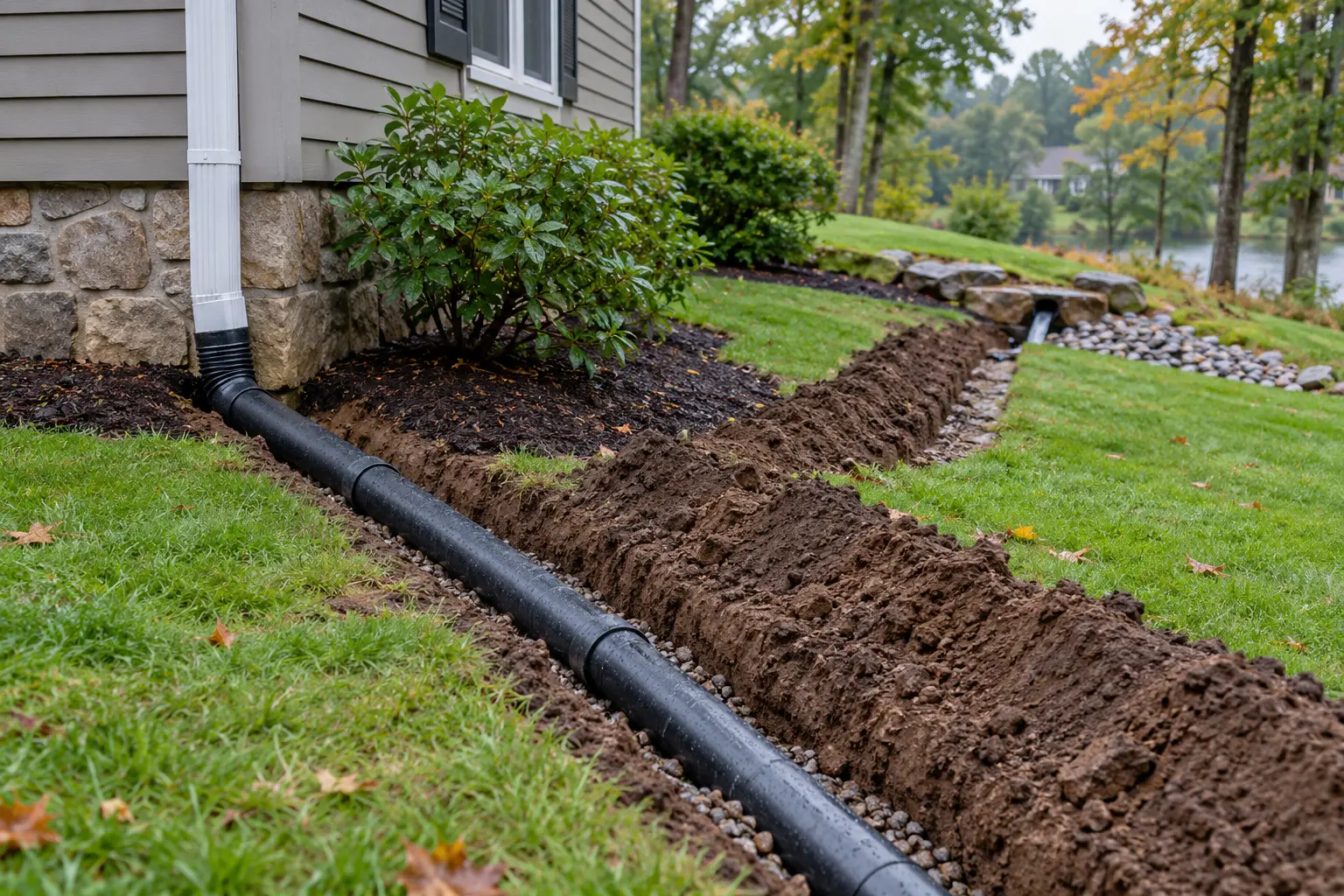
Most wet basements in Connecticut don't start with groundwater. They start at the gutter. A downspout that dumps a few hundred gallons against your foundation every storm will eventually find the weak spot in the basement wall. And in Central Connecticut, the storms delivering that water are getting bigger.
This guide walks through how much water your roof actually sheds, where Connecticut rules say that water can and can't go, and the practical options for moving it away from your house for good, from a $20 extension to a buried dry well.
Your Roof Is A Bigger Water Source Than You Think
One inch of rain falling on one square foot of roof produces about 0.62 gallons of water. Texas A&M AgriLife Extension uses that standard conversion, and it adds up quickly.
Take a typical Glastonbury colonial with roughly 1,400 square feet of roof area:
| Rain event | Approximate runoff from a 1,400 sq ft roof |
|---|---|
| 1-inch storm | ~870 gallons |
| 2-inch storm | ~1,740 gallons |
| One average Hartford-area year (~47 inches) | ~41,000 gallons |
Split that across four downspouts and each corner of the house handles more than 200 gallons in an ordinary one-inch rain. If a downspout ends at a splash block a foot from the wall, most of that water soaks straight into the backfill. That's the loosest, most disturbed soil on your lot, and it sits right against your basement.
Connecticut's Rain Is Getting Heavier
The Hartford area averages roughly 46 to 49 inches of precipitation a year, based on NOAA's 1991–2020 climate normals. But averages don't flood basements. Downpours do.
The Fifth National Climate Assessment found that the Northeast has seen about a 60% increase in heavy precipitation since the late 1950s, the largest jump of any U.S. region. NOAA expects that trend to continue through the rest of this century.
For homeowners, that means gutters, leaders, and drain lines sized decades ago are now handling 2- and 3-inch storms more often. A system that was "fine for years" can start failing without anything changing on the house.
Soil makes it worse. Much of Glastonbury, Manchester, Wethersfield, and the surrounding towns sits on glacial till. The USDA's description of the Wethersfield soil series, common throughout the Connecticut Valley, notes it formed in dense basal till. That dense layer slows water from draining down. When water can't soak down, it moves sideways, and very often it moves along your foundation wall.
Where Roof Water Is Not Allowed To Go
Not into the sanitary sewer. This is the one hard rule. The City of Bristol states plainly that roof drains and sump pumps discharging to the sanitary sewer are illegal in Bristol and in every other Connecticut municipality. The extra clean water overloads sewer pipes and pumps, and it contributes to sewage backups during storms, sometimes into your own basement.
Towns are getting serious about it. In 2026, Darien adopted a sump pump ordinance with $250 fines. Its sewer commission estimates that 10 to 20% of sewer users may have sump pumps or downspouts illegally tied in.
If you own an older home and your downspouts disappear into the ground, find out where they go. Some connect to old clay or cast-iron lines that collapsed decades ago. Others tie into the house sewer. A camera inspection costs far less than a flooded basement or a municipal violation.
Not onto your neighbor. Concentrating roof water and aiming it at the property line is a fast way to start a dispute. A good drainage plan keeps water on your lot long enough to soak in, or routes it to an approved discharge point. If you're thinking about tying into a street catch basin or discharging at the curb, check with the town first.
The Code Baseline: 6 Inches Of Fall In The First 10 Feet
Connecticut's current State Building Code is built on the 2021 International Residential Code. Section R401.3 requires the ground to fall at least 6 inches within the first 10 feet away from the foundation. Where lot lines, walls, or slopes make that impossible, the code calls for drains or swales instead. Patios and walkways within 10 feet of the house must slope at least 2% away from it.
Plenty of older Connecticut homes no longer meet that standard. Foundation backfill settles over time, mulch beds get built up against the siding, and a patio that once pitched away slowly tilts back toward the house. Before spending money on underground drainage, check whether your grade still does its job.
Your Options, From Simplest To Most Permanent
Downspout extensions and splash blocks. Cheap and fast. The goal
is to discharge at least 6 to 10 feet from the foundation. The downside: mowers can run them over, they can come loose, freeze in place, and dump water across a walkway that ices over in January.Solid pipe to daylight. A buried solid PVC line carries each
downspout to a lower spot on the property, ending at an open outlet or a pop-up emitter. This is the cleanest long-term fix when your lot has somewhere downhill for the water to go. The pipe needs a continuous slope (1% or better is a common target) and a protected outlet that won't freeze shut or get buried by landscaping.Dry wells. When there's no downhill outlet, a dry well stores
roof water underground and lets it soak in over time. Connecticut's Stormwater Quality Manual describes dry wells as open-bottom structures or stone-filled pits, and notes that clean roof runoff doesn't need pretreatment. For scale: capturing one inch of rain from a 350 sq ft roof section is about 220 gallons, or roughly 29 cubic feet of water. Because crushed stone is only about 40% open space, that takes a stone pit of roughly 70 to 75 cubic feet. The catch is soil. The state manual calls for a soil evaluation before designing infiltration systems, and a dry well dug into dense till can fill up and just sit there.Rain gardens. A shallow planted basin that collects downspout
water and lets it soak in. UConn's NEMO program says a typical residential rain garden runs 50 to 100 square feet. It recommends keeping it at least 10 feet from a house with a basement. UConn also offers a free Rain Garden app with a sizing calculator.Regrading and swales. If water is coming at your house from
across the whole yard, not just off the roof, downspout fixes alone won't solve it. Reshaping the grade or cutting a shallow grassed swale redirects surface water before it reaches the foundation.
Common Downspout Drainage Mistakes
These are the problems that show up again and again on Connecticut properties:
Perforated corrugated pipe off a downspout. It leaks roof water
back into the soil right next to the foundation, clogs with shingle grit, and crushes under a lawn tractor. Roof leaders should run in solid pipe.An outlet nobody can find. A buried pipe with no daylight end or a
pop-up covered by sod isn't draining anything. Water backs up, freezes, and splits the pipe.Tying roof water into the footing drain. Foundation drains relieve
groundwater, not every gallon off the roof. Overloading them can push water back toward the wall.Dry wells without a soil test. In tight till or clay, an untested
dry well turns into an underground bathtub.Ignoring the gutters. Clogged or undersized gutters overflow along
the whole eave, so no downspout fix helps. Clean them in spring and fall.
Why Elevated Earthwork
Explore our related services →
Elevated Earthwork is a family-owned excavation and drainage contractor based right here in Glastonbury. Our team brings more than 15 years of commercial and industrial experience to residential and light-commercial properties across Central Connecticut.
When we look at a drainage problem, we look at the whole property: where the roof water goes, how the lot is graded, what the soil does after a storm, and where water can legally and practically leave the site. Depending on what we find, the fix might be solid pipe to daylight, regrading, a French drain, a catch basin, a swale, or a combination. We don't sell one solution to every yard.
Local soil experience. We work in Glastonbury's glacial till and
valley soils every week, and we plan around Connecticut's 42-inch frost depth.Licensed and insured. Connecticut Home Improvement Contractor
registration HIC.0666048.Proven with homeowners. A 5.0 Google rating, with strong reviews
on BBB, Angi, and Facebook. One Angi reviewer noted that Kevin "took careful consideration to drainage around our court and throughout the yard."Straight communication. Clear expectations and fair pricing from
the first estimate through final cleanup.
We serve Glastonbury, South Glastonbury, East Glastonbury, Hebron, Marlborough, Manchester, Wethersfield, Rocky Hill, West Hartford, and nearby towns. If water is pooling at your foundation or your basement gets damp after every storm, call (860) 491-8964 or request a free estimate. Photos of the problem area after a rain help us give you a faster, more accurate answer.
Frequently Asked Questions
How Far From My House Should Downspouts Discharge?
Aim for at least 6 to 10 feet, and make sure the ground slopes away from the house at the outlet. Connecticut's building code requires at least 6 inches of fall in the first 10 feet from the foundation, so water released inside that zone should still run away from the wall.
Can I Connect My Downspouts Or Sump Pump To The Sewer In Connecticut?
No. Roof drains and sump pumps discharging to the sanitary sewer are prohibited in Connecticut municipalities. Some towns, including Darien, now fine property owners for illegal connections.
Will A Dry Well Work On My Property?
It depends on your soil. Sandy or gravelly soils in parts of the Connecticut River valley can drain well. Dense glacial till, common in the uplands around Glastonbury, often drains slowly. A simple percolation test before digging tells you whether a dry well will empty between storms.
Should I Bury My Downspouts?
Buried solid pipe is usually the best long-term solution, as long as there's a downhill outlet and the line has continuous slope. Avoid perforated or corrugated pipe for roof water, and make sure the outlet stays clear and won't freeze shut.
How Much Does Downspout Drainage Cost?
A few extensions cost very little. We price buried solid pipe to daylight, dry wells, or regrading by length, depth, access, and soil conditions. A site visit is the only way to give an accurate number.
Is A Rain Garden A Good Fit For A Connecticut Yard?
Often, yes, if you have a reasonably flat spot at least 10 feet from the house and soil that drains within a day or so. UConn's NEMO program has free tools to help size one.
Sources
- Fifth National Climate Assessment, Chapter 2: Climate Trends
- Prepare for more downpours
- Average Annual Precipitation for Connecticut
- Rainwater harvesting: 0.62 gallons per square foot per inch
- Connecticut State Building Code regulations
- 2021 IRC Section R401.3 Drainage
- Is it legal to connect a basement sump pump to the sanitary sewer?
- Darien RTM approves sump pump ordinance with \$250 fines
- Dry Well & Infiltrating Catch Basin
- Connecticut Stormwater Quality Manual
- Rain Gardens
- Siting and Sizing
- Wethersfield Soil Series